Projects

Everything here is on GitHub and open source. Most of it began as code he kept copying from one job to the next and finally gave its own home.

slughorn

A C++20 library for GPU vector graphics, built on Eric Lengyel’s Slug technique.

Slug renders text and vector shapes by evaluating the exact curve equations for each pixel in the fragment shader. Edges stay sharp at any zoom, transforms cost nothing, and perspective comes out correct because nothing was approximated with triangles. When Lengyel dedicated the Slug patent to the public domain in March 2026 and released his reference shaders under the MIT license, Jeremy started slughorn within three weeks. Nearly every commit since is his.

slughorn handles everything before the GPU. It takes vector data, reduces it to quadratic Bézier curves, and packs them into the curve and band textures that the Slug shaders read. It makes no assumptions about the graphics API: OpenGL, Vulkan, WebGL, WebGPU, Metal and DirectX are all fair game. Most GPU vector renderers want to own the authoring. slughorn is built so you can bring your own.

What goes in

  • Fonts through FreeType, including COLRv0 and COLRv1 color emoji with their gradients and transforms
  • SVG through NanoSVG, paths and gradients
  • Paths from Cairo, Skia and Blend2D
  • Shapes drawn directly with a native API modeled on the HTML Canvas element
  • Anything else that reduces to quadratic curves, through one helper class

What comes out

Shapes and layered composites with linear, radial and sweep gradients, masks, text set along any path, inside and outside glow effects from MSDF data, per-layer shader fills, compute-shader sources, and full PBR with image-based lighting on any surface, flat or curved. Python bindings cover offline asset work, and a glTF-compatible JSON format saves it all.

Why not Skia

His README takes the question head on. Skia’s GPU backends tessellate curves into triangles, so quality depends on a tolerance, perspective is approximated, and Skia wants to own the OpenGL context. Slug is a shader and two textures, and it drops into a scene graph like any other program. For a fixed-resolution 2D interface, he says, Skia is the better tool. For text on a billboard, a HUD, a curved surface or anything seen through a perspective camera, Slug wins.

In progress

GPU stroking, which is sponsored, plus a pattern API, decal-style rendering and published Python packages. Porter-Duff compositing and more Blend2D and NanoSVG features are planned.
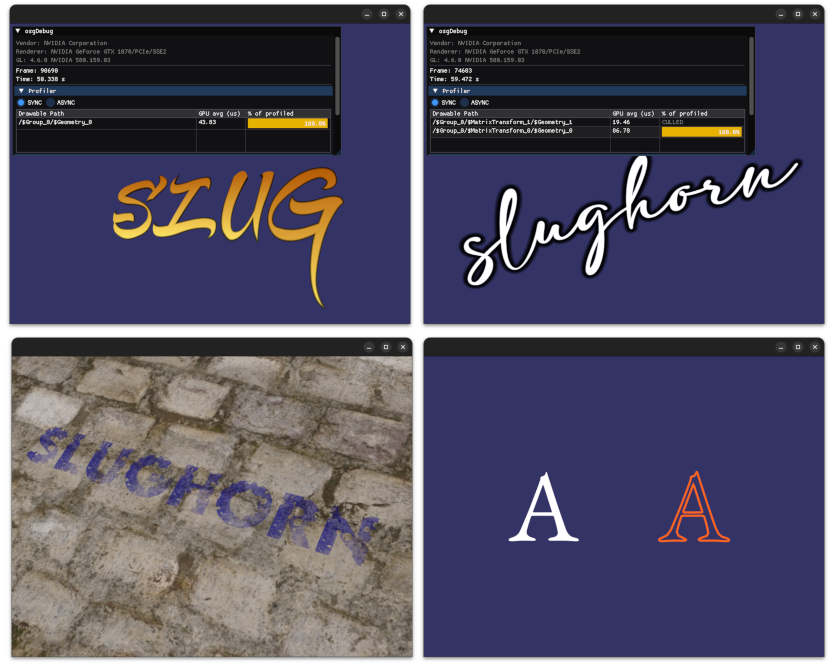

Four osgSlug windows: SLUG in a gold gradient, slughorn in script with a white outer glow, SLUGHORN laid in perspective across a cobblestone texture, and a serif A shown filled and as an outline
Text effects: gradient fill, outer glow, perspective, fill and stroke.
Nine color emoji rendered by slughorn: fire, rainbow, crystal ball, diamond, butterfly, wave, dragon, fireworks and sunrise
COLRv1 color emoji, each layer its own shape.
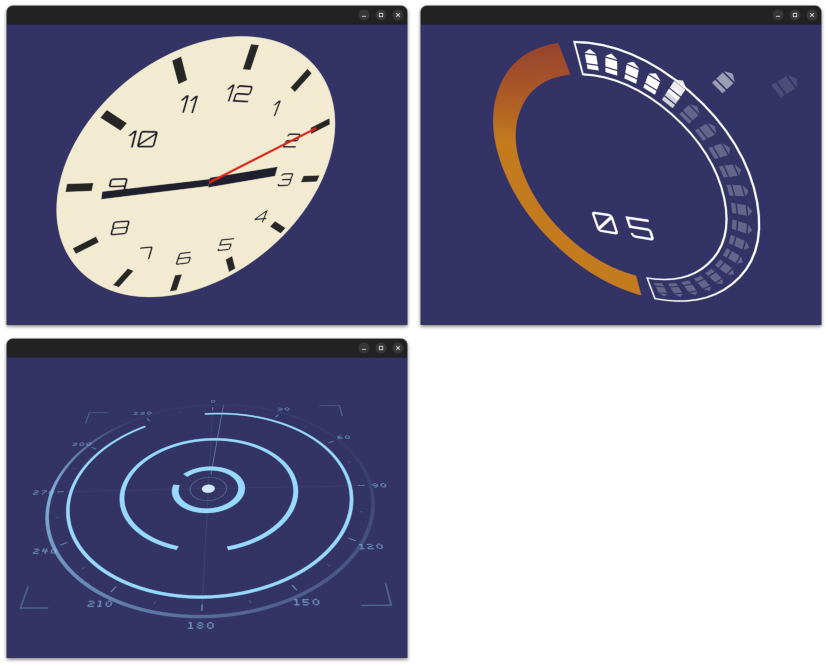
Three HUD examples: a tilted analog clock face, a curved orange gauge with a segmented arc and the number 05, and a blue radar compass ring
HUD elements, flat or tilted into 3D.
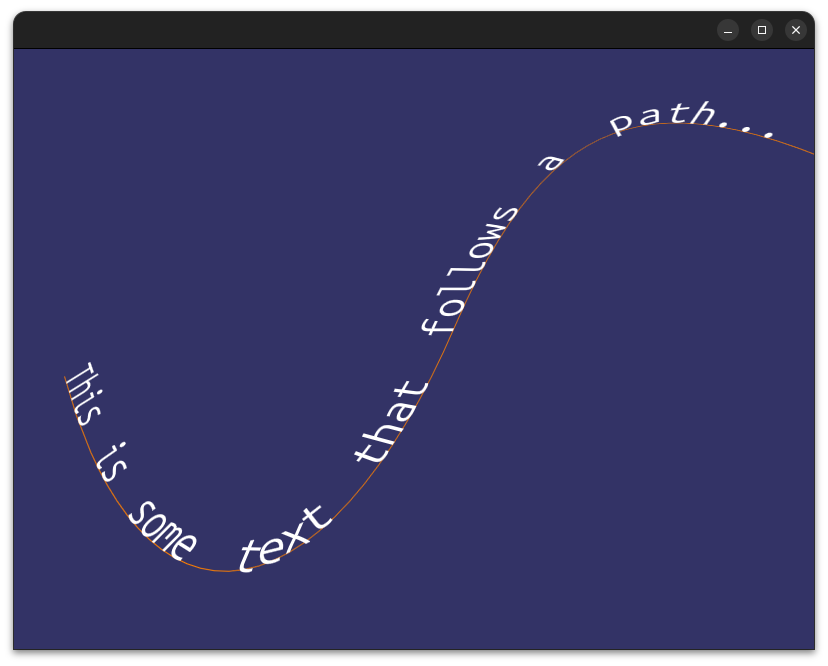
The sentence This is some text that follows a path, set along an S-shaped orange curve
Glyphs placed along a path.

The OpenSceneGraph frontend for slughorn, and the testbed every image above was captured from. slughorn has no graphics dependencies of its own. osgSlug proves the integration works and serves as the reference for wiring slughorn into other renderers. Both projects are open source on AlphaPixel’s GitHub.

OpenSceneGraph

C++

The GUI toolkit inside OpenSceneGraph itself. His first large contribution to the project, written 2007 to 2008.

C++20

Extras for OSG. Optional subsystems for GL_KHR_debug and GPU profiling, a Dear ImGui overlay, EGL and GBM windows without X11, a glTF 2.0 loader with PBR and image-based lighting, and KTX2 textures. Python bindings through pybind11.

C++

Text for OSG through Pango and Cairo, with layered effects such as shadows, outlines and bitmap fills. It received outside development funding.

The layer that lets Cairo draw efficiently into OSG.

C++

Vector drawing in OSG through NVIDIA’s path rendering extension.

C++

OpenSceneGraph support for the Rive vector graphics runtime. New in 2026.

Building OpenSceneGraph for the browser with WebAssembly and Emscripten.

C++

Working examples of OSG and osgEarth inside Qt 6, including the environment settings that save an afternoon.

C++

OSG on a Raspberry Pi, plus the cross-compile script. Building OSG on the Pi itself “would probably take longer than just rewriting a new scenegraph yourself”.

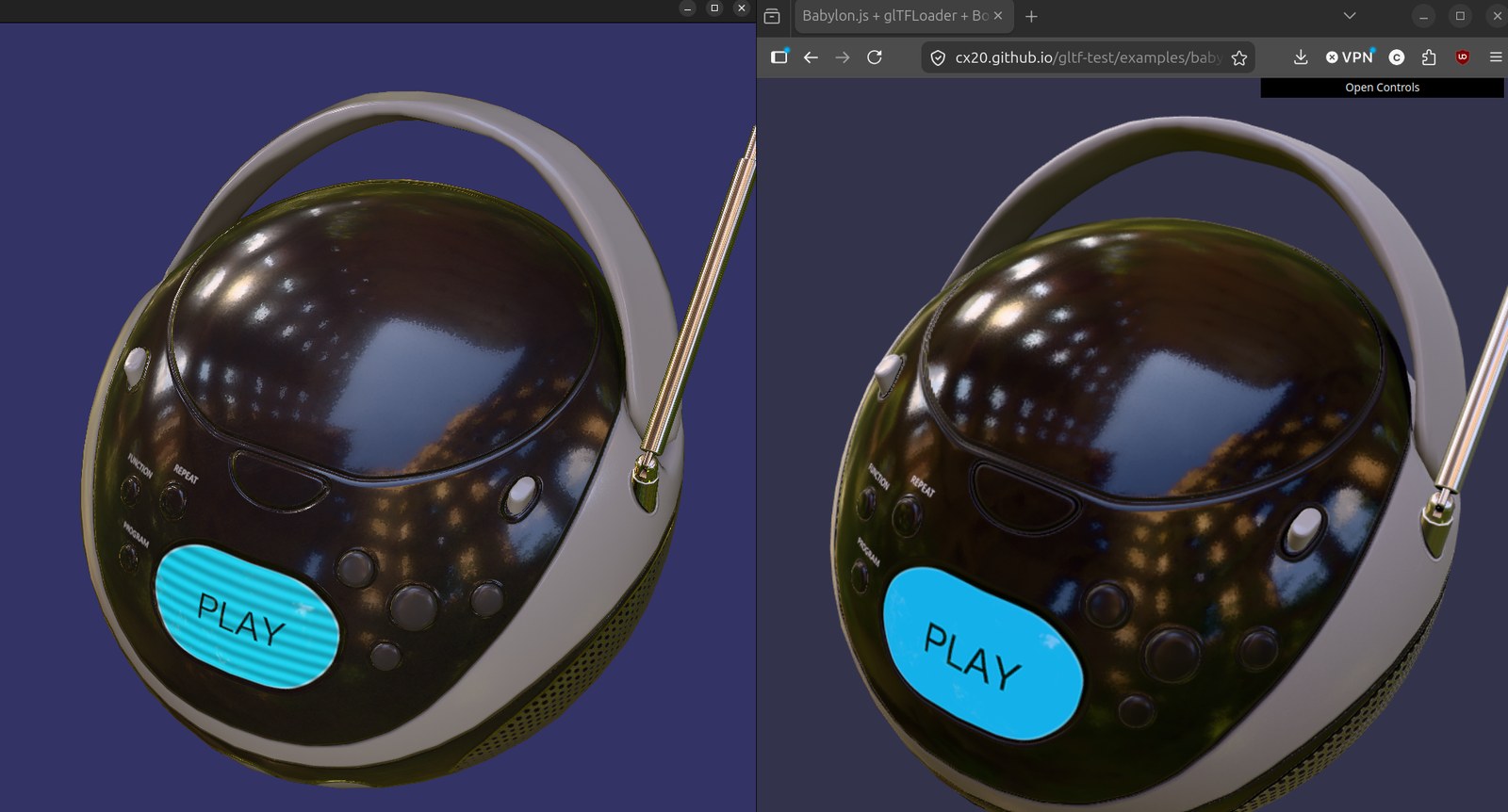
A glTF model of a portable CD player rendered by osgx, beside the same model rendered by BabylonJS
osgx's glTF renderer (left) beside BabylonJS, same model and lighting.

Cairo

C

A small library of common Cairo routines, formerly Cairocks. C-linkable API, with a Python example through cairocffi.

A test bed for Cairo’s OpenGL backend with SDL2 and GL/GLES2. He measured it at about twice the speed of the image backend.

A starting template for Cairo drawing into an HTML5 canvas.

Video

C

A C library for decoding WebM, pronounced “imbue”. Sponsored by AlphaPixel.

C++

Qt 6 RTSP playback examples with VLC and FFmpeg, and a GStreamer test server.

Embedded Linux

BitBake

A Yocto layer for the NVIDIA Jetson TK1. Plenty of people forked it. His README asks them to send their changes back.

A Yocto layer for OpenSceneGraph and its nodekits.

A Yocto layer for the Intel ECM-QM87 board.

Systems and build tooling

A setuid helper that lets ordinary users create TUN/TAP interfaces for QEMU.

Ruby

Ruby wrappers for QEMU’s QMP guest-agent commands.

A CPython extension for querying ISC DHCP server leases.

Scripts for driving the MSVC build tools with CMake from inside WSL2.

CMake

A minimal AddressSanitizer setup in CMake.

Small libraries

C99

A one-header, one-source profiler with Windows, clock_gettime and RDTSC timing.

C++17

A header-only profiler that stores timings as a graph.

A container library for plain C.

Python

A SQLAlchemy starter file, named for the alchemist Nicolas Flamel.